Not every role belongs offshore, and pretending otherwise doesn't do a business any favors. Here's the honest version of which roles fit a remote back-office team and which ones don't.
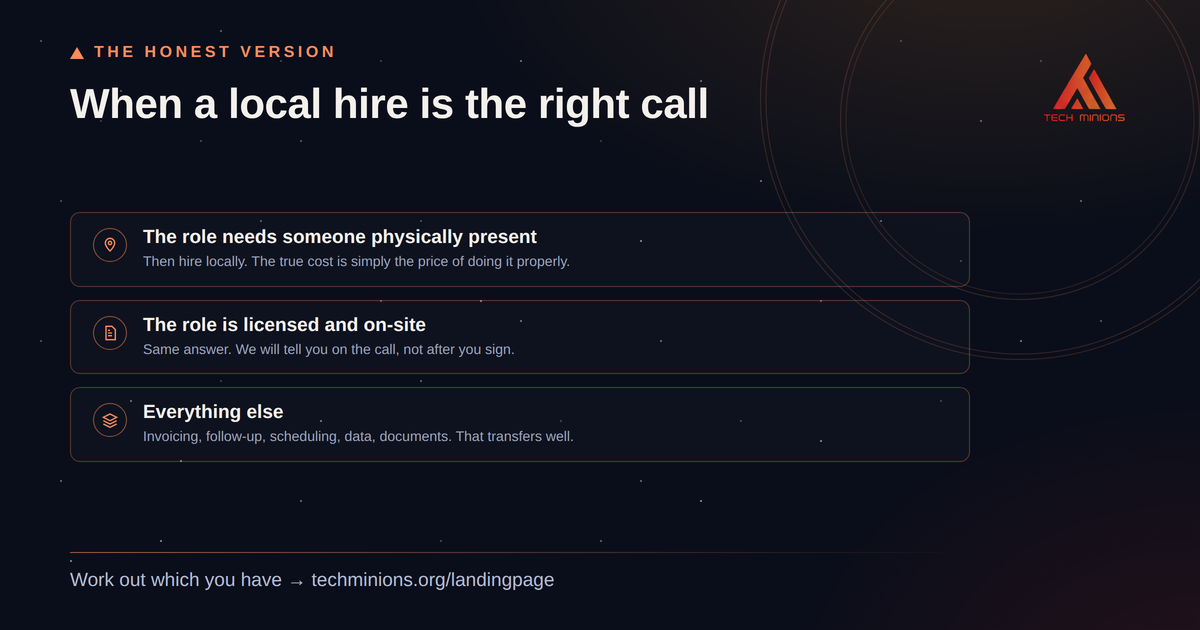
The role needs someone physically present
If the job requires someone standing in the building, on the job site, or in front of a customer in person, the answer is simple: hire locally. The true cost of that role is just the price of doing it properly, and no back-office arrangement changes that.
The role is licensed and on-site
The same answer applies to roles that require a specific local license combined with being on-site. This gets said upfront, on the discovery call, not after a contract is signed and the mismatch becomes someone else's problem to untangle.
Everything else
Invoicing, follow-up, scheduling, data entry, and document management are a different story. That kind of work transfers well to a remote back-office team, because none of it depends on physically being in a specific place.
An illustrative example
Picture a home-service trades business asking TechMinions to handle both the licensed on-site inspections and the office-side scheduling and invoicing. The honest answer on the discovery call is that the inspections need a locally licensed technician, full stop, but the scheduling, follow-up calls, and invoicing that support those inspections are exactly the kind of work that transfers well to a dedicated back-office team.
This is a worked example to illustrate how the split between local and remote work gets decided. It is not a real TechMinions client story.
Work out which you have
Prefer to talk it through first?
#BackOfficeOperations #HonestAdvice #WhenToOutsource #SmallBusinessTips #SMEGrowth #Outsourcing #BPO #LocalHiring